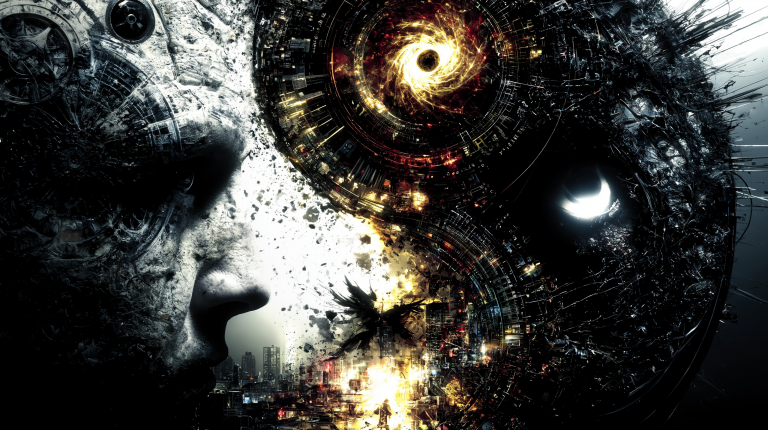
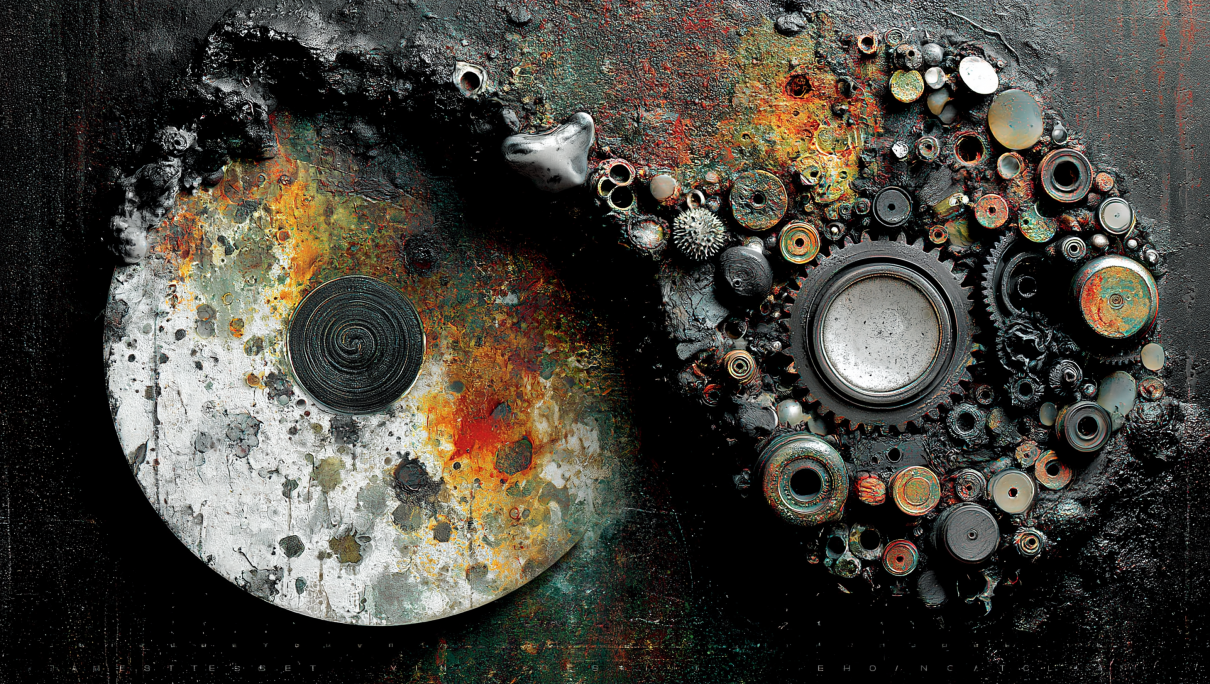
There is a quiet tension at the heart of modern digital creation. On one side, you have the sorcerer—the generative AI that deals in dreams and diffusion. On the other, you have the architect—the precision tool that bends every binary bit to its will.
For years, we have been told to pick a side. Either embrace the beautiful, unpredictable chaos of iterative models like Midjourney, or worship at the altar of absolute control with tools like Nano Banana Pro. But after spending months deep in both trenches, I’ve realized something counterintuitive: They are not competitors. They are two halves of a whole creative brain.
And the secret to unlocking actual productivity and design value isn’t choosing one—it’s learning to dance between the two.
The Poetry of Iteration: Lessons from „Midjourney“
Let’s start with the name itself: Midjourney. Not „Final Destination.“ Not „Perfect Render.“ Midjourney. The name is a thesis statement. It implies that you are always in between states. You are on a path, not at a peak.
Using Midjourney feels like sketching with a divining rod. You type a prompt—a vague hope, really—and what comes back is rarely what you asked for, but often something better. You learn to listen to the mistakes. A melted clock face becomes a surrealism study. A distorted hand becomes an abstract sculpture.
The beauty here is emergent design. You are not controlling the pixel; you are curating the possibility. Each iteration is a conversation with a muse who has read every art history book but has no hands. You zoom out. You remix. You vary the seed.
The value for productivity is counter-intuitive: You waste less time over-thinking. Because you cannot dictate the exact pixel, you stop trying to. Instead, you generate 50 variations in the time it would take to draw one straight line. You steal the signal from the noise. Midjourney excels at discovery—finding the composition, the lighting, or the vibe you never knew you wanted.
The Binary Control: The Gospel of Nano Banana Pro
Now, enter the anti-Midjourney: Nano Banana Pro. If Midjourney is watercolor in a rainstorm, Nano Banana Pro is a CNC milling machine. It is precise. It is unforgiving. It is glorious.
The name „Nano Banana“ sounds playful, but don’t be fooled. „Nano“ speaks to the atomic level of control—the ability to manipulate the smallest unit of your image. „Banana“ (in the colloquial design sense) implies a standard of measure, a calibration tool. You use it to establish scale, logic, and structural truth.
Where Midjourney hallucinates, Nano Banana Pro specifies. We are talking about binary control: pixel-perfect masking, mathematical bezier curves, non-destructive layer states, and exact color values (HEX, CMYK, Lab). This is the tool for the vertical moment of creation.
Here, you are not curating; you are engineering the pixel. You tell the red channel to be 255, the green to be 0, and the blue to be 128. And it obeys. Immediately. Absolutely.
The productivity here is linear and predictable. You know that if you perform action X, you get result Y. This is how you ship a final asset to a client who demands „the logo is exactly 4.2cm from the left margin.“ Nano Banana Pro kills ambiguity. It takes the beautiful chaos from Midjourney and welds it into a functional chassis.
The Two Philosophies of the Pixel
To truly benefit, you have to respect the difference in their core mechanics:
-
Midjourney (Diffusion & Latent Space): You are a gardener. You plant seeds (prompts) and till the soil (parameters). You wait for the flowers to bloom, then you pick the best ones. You don’t control the shape of the petal; you control the environment.
-
Nano Banana Pro (Raster & Vector Logic): You are a mason. You place one brick (pixel) at a time. You check the level. You mix the mortar. If a brick is wrong, you remove it. You don’t ask the wall for permission; you command it.
Most designers fail because they try to force Midjourney to be a mason („Make the third eyelash 2px longer“) or force Nano Banana Pro to be a gardener („Just generate a creative concept for me“). It breaks every time.
The Hybrid Workflow: How You Win
The true value for design and productivity lies in a handshake protocol between the two.
Phase 1: The Divergent Storm (Midjourney)
You have a blank page. You need a concept for „a cyberpunk library where books grow on trees.“ Open Midjourney. Iterate 100 times. Fail fast. Find the three weird, wonderful, impossible images that make your stomach flip. This takes 20 minutes. You now have a direction.
Phase 2: The Convergent Edit (Nano Banana Pro)
You take that winning Midjourney image. You import it into Nano Banana Pro. Now the real work begins. You fix the anatomy. You change the typography. You replace the random gibberish text with actual readable words. You adjust the lighting to match your brand’s color palette. You remove the extra fingers.
Phase 3: The Iterative Loop
Here is the magic. You don’t stop. You take your Nano Banana Pro edit, feed it back into Midjourney as an image prompt, and say, „Yes, like this, but make the mood darker.“ Midjourney re-interprets your precision edit through its dreamy lens. You get a new hybrid. Then back to Nano Banana Pro for the final polish.
The Bottom Line
You need the Nano to survive the detail work. Without it, your designs are sloppy, unprofessional, and unusable. But you need the Midjourney to survive the creative desert. Without it, your designs are technically perfect, emotionally dead, and boring.
Don’t ask which tool is better. Ask which phase of creation you are in right now.
Are you searching for the soul of the image? Call on Midjourney.
Are you defending the integrity of the output? Call on Nano Banana Pro.
In the end, great design isn’t about controlling every pixel or surrendering to every ghost. It is about knowing when to hold the pixel accountable, and when to let the journey surprise you.
Iterative design is the game where every version makes you stronger — and every failure becomes fuel.
WEBSTERIX